Mixture of Experts (MoE) Explained Simply: Kimi K3 Has 2.8 Trillion Parameters and Uses 104 Billion
A zero-background guide to how giant AI models stay cheap: experts, routers, and the two numbers that matter more than the headline.
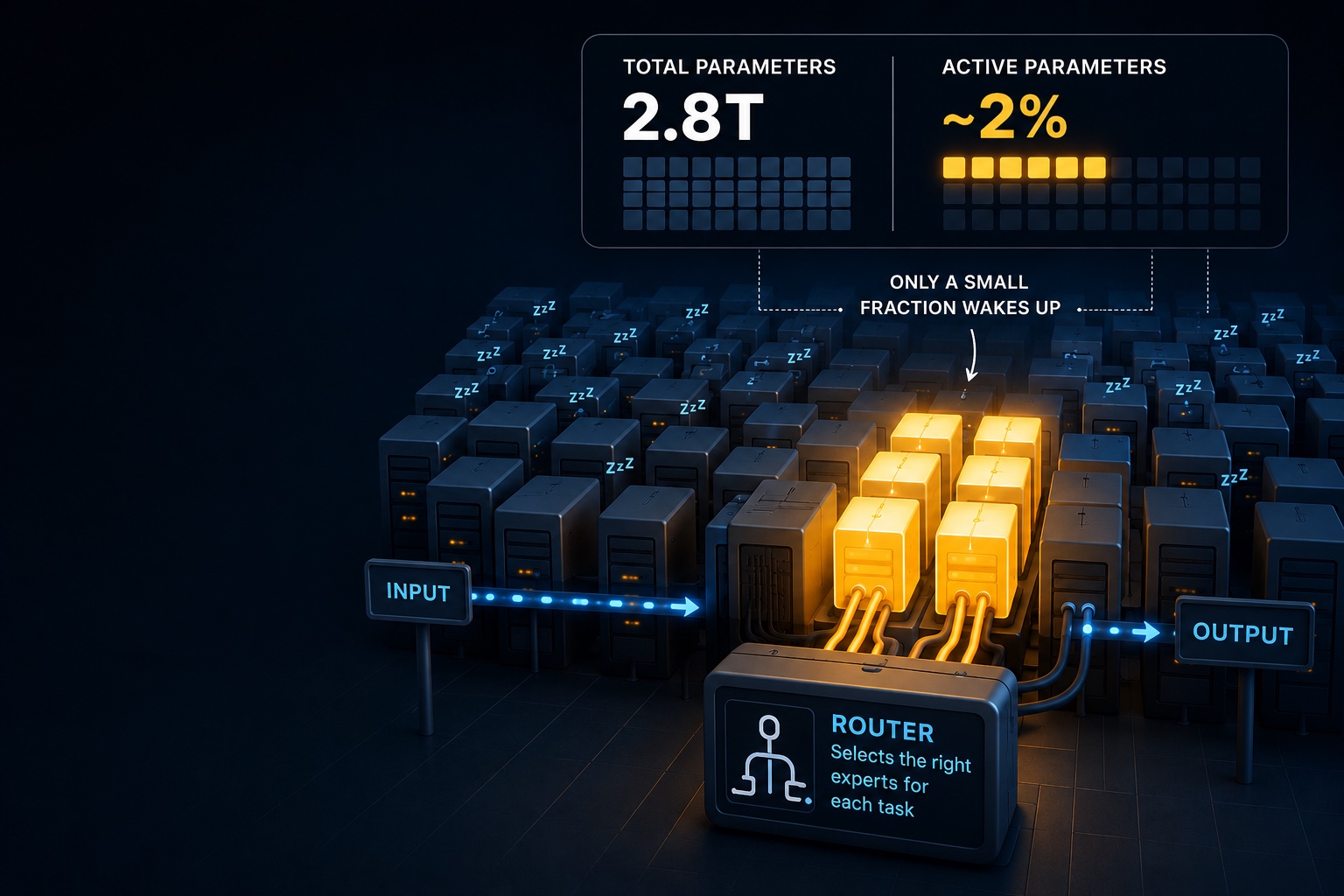
Kimi K3 is called a 2.8 trillion parameter model.
The surprising part? Only about 104 billion of those parameters do any work for a given word. That is under 4 percent, confirmed from the model files Moonshot published on 27 July 2026 [14].
That is not a bug. It is the biggest architectural shift in modern AI. Here is how it works, explained from zero. No math. No background needed. By the end you will also know the real technical words.
First, the news context in one line: Kimi K3 was announced on July 16 by Moonshot, a Chinese lab, as the largest open-weight AI model ever [14]. “Open” means anyone can download the model files for free.
What are parameters in an AI model?
An AI model is a huge pile of adjustable numbers. Billions of them. A long, automatic practice process slowly tunes these numbers until the model can predict the next word well. That process is called training. The numbers are called parameters.
When you read “a 70 billion parameter model”, it means: a pile of 70 billion tuned numbers.
Now the question this whole story is about: to write ONE word of an answer, must ALL those numbers do work?
What is a dense model? Every parameter works on every word
Classic AI models answer: yes. To write one word, every parameter does work. Scientists call this a dense model. Dense means: everything is active, all the time.
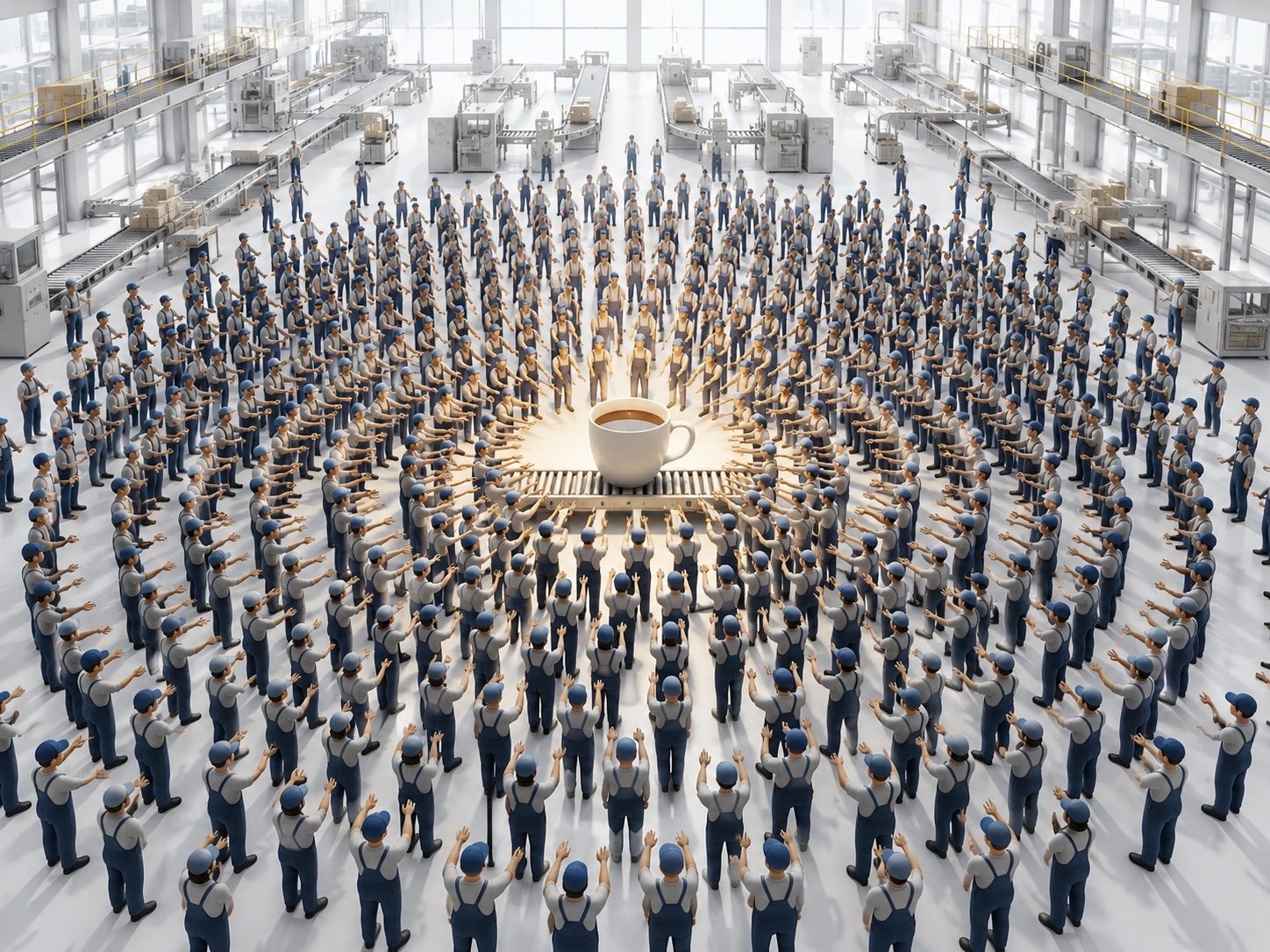
Imagine a factory where every worker must touch every product. Even one cup of coffee needs all 70,000 employees. It works, but it is slow and very expensive. This is why bigger AI kept meaning slower and more expensive AI.
What is a Mixture of Experts (MoE) model?
Around 2021-2024, an idea from the 1990s came back: stop making every parameter work on every word.
One more word first. A model is built as a stack of repeated processing steps. Each step in the stack is called a layer.
Inside each layer, two things happen. First, the words in your sentence look at each other, like a team meeting where everyone shares context. Then each word goes off to be processed on its own, like each person going back to their desk to think after the meeting. That second part, the desk work, is the expensive part. It is where most of the parameters live.
The idea: cut that desk-work part into many small blocks. Add a tiny decision-maker. For each word, the decision-maker picks a few blocks to wake up. The rest stay asleep and cost nothing.
The names: the small blocks are experts. The decision-maker is the router. The whole design is called Mixture of Experts, or MoE. When you see “MoE” in the news, it means exactly this: a big model where only a small piece works per word.
A real example from Mixtral, released in December 2023 by Mistral, a French lab [6]. Each layer has 8 experts, and the router picks 2. The model holds 47 billion parameters, but each word only uses about 13 billion. You store a big model. You pay for a small one.
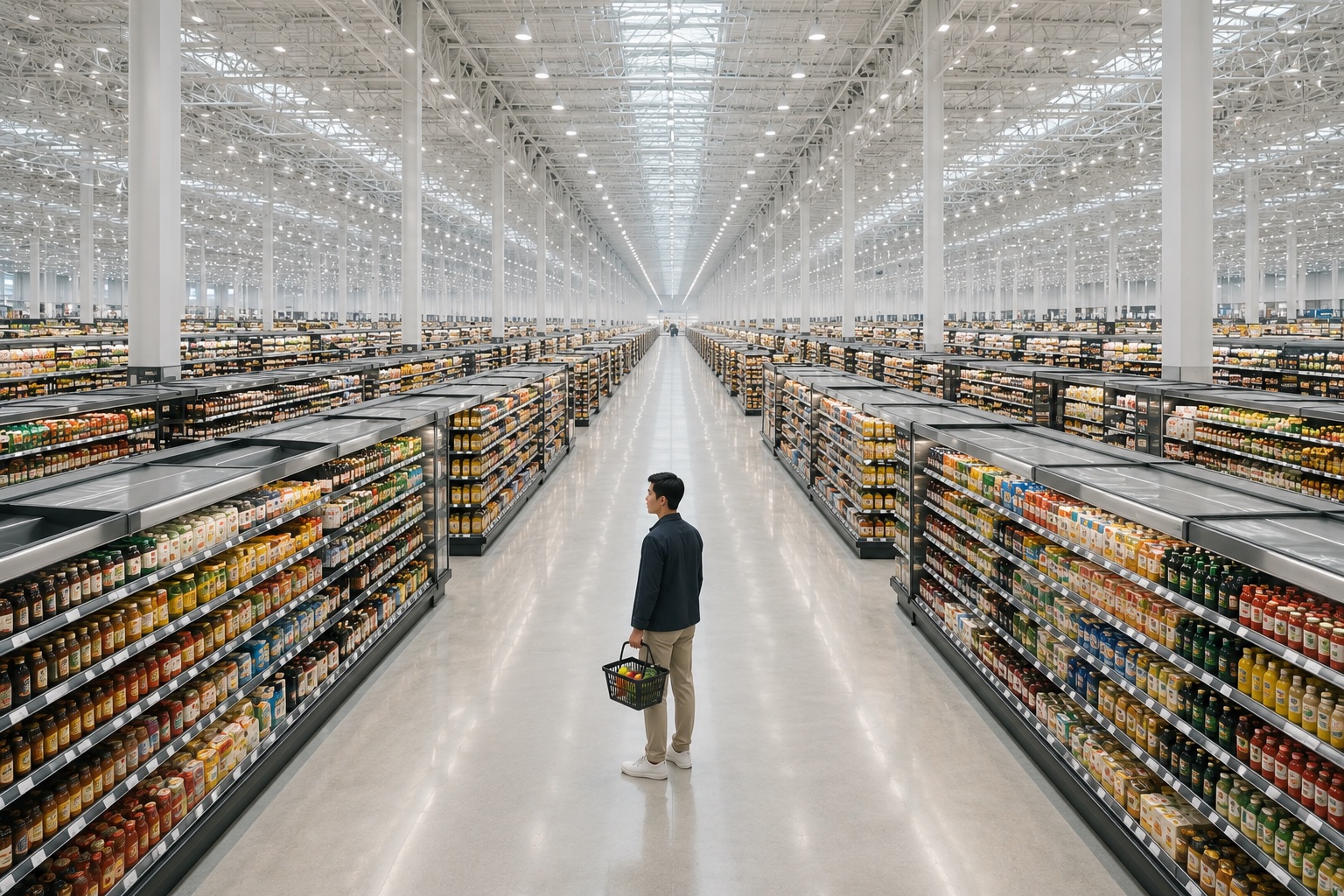
A picture that helps: a dense model cooks every meal from one small home pantry. An MoE model shops in a giant supermarket, but fills only one small basket for each dish.
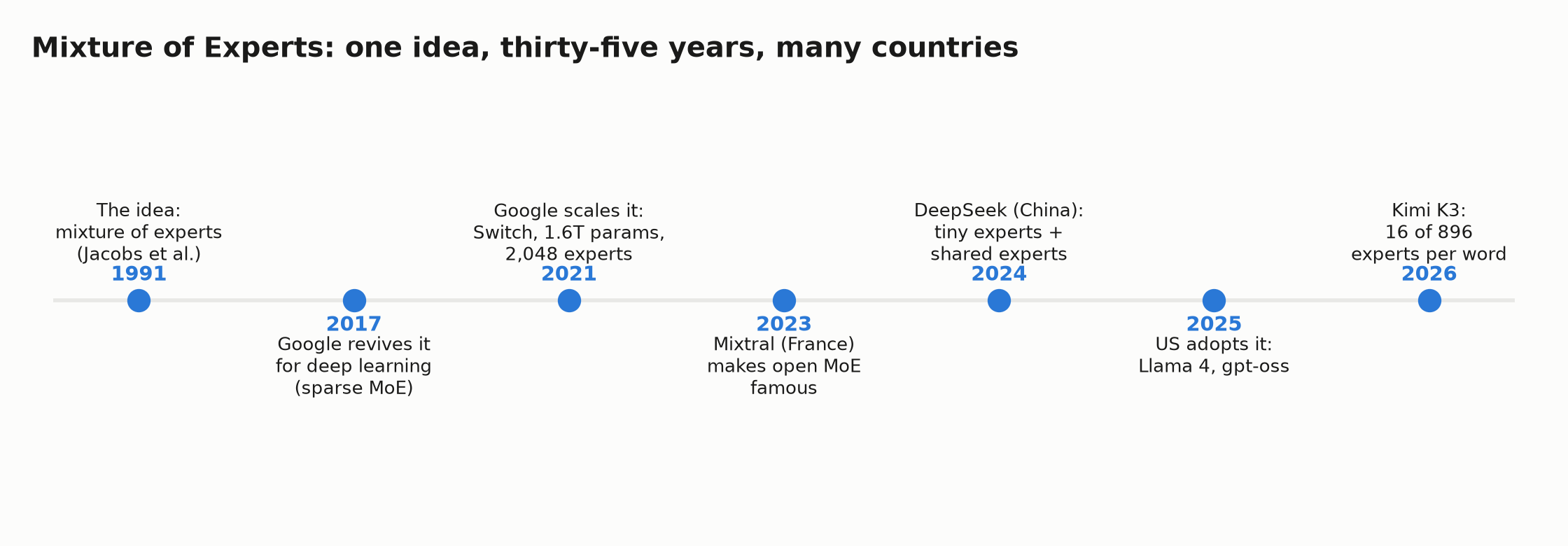
A short history, because this idea is not new and not from one country. The mixture-of-experts concept was published in 1991 [1]. Google revived it for modern AI in 2017 [2].
By 2020-2021, Google was already training models with thousands of experts and over a trillion parameters [3][4]. Google says its Gemini models use MoE [13]. Mistral in France then made the idea famous in open models [6].
Today, Meta's Llama 4 [11], OpenAI's gpt-oss [12], xAI's Grok [7], and Databricks' DBRX [8] are all MoE models too. This is world engineering, not one country's secret.
The expert myth: MoE experts are not human-style specialists
Here is where most explanations get it wrong, including my supermarket picture above.
You would expect a “math expert” and a “poetry expert”. That is not what happens. Researchers looked inside Mixtral and found no clear subject specialists [6]. Instead, experts specialize in strange things: code indentation, the word “self” in Python programs, runs of neighboring words. Even in the very first 2017 study, the patterns were sometimes recognizable but never school subjects: one expert kept receiving adjectives, another kept receiving words like “a” and “the” [2]. Patterns that help the machine, not subjects a human would choose.
Why? Because nobody assigns the jobs. During training, the router simply learns that sending similar word-pieces to the same expert reduces errors. Scientists discuss this as expert specialization, and the key fact is that it is emergent: nobody designs it, it appears on its own.
Three more common mistakes, corrected in one line each:
- An MoE is not several small AIs with a manager choosing between them. The routing happens deep inside, for every word, at every layer.
- You cannot take one expert out and use it as a small model. The parts only work together.
- MoE does not save memory. All experts must stay stored in memory. What it saves is the work done per word. That work has a name: compute.
Fine-grained experts and shared experts: DeepSeek's design
In January 2024, weeks after Mixtral appeared, the Chinese lab DeepSeek published a design that pushed the idea further [9]. DeepSeek did not invent MoE. It refined how the experts are organized. Google had already tried thousands of experts [3], but each word still used just one or two big ones. Microsoft had already tried an always-awake helper expert in 2022 [5]. DeepSeek combined and sharpened both moves:
One. Slice every expert into much smaller pieces, and wake up MORE of them per word, for the same total work. Instead of 8 big departments, think 256 small teams. There are vastly more ways to combine the right small teams for each word.
Two. Keep one or two experts that never sleep. They see every word and handle the common, boring work, so the small teams never repeat it. Like the front desk of a hotel.
The names: fine-grained MoE, and the always-awake part is a shared expert.
The result was a race, across all labs, toward using less of the model per word:
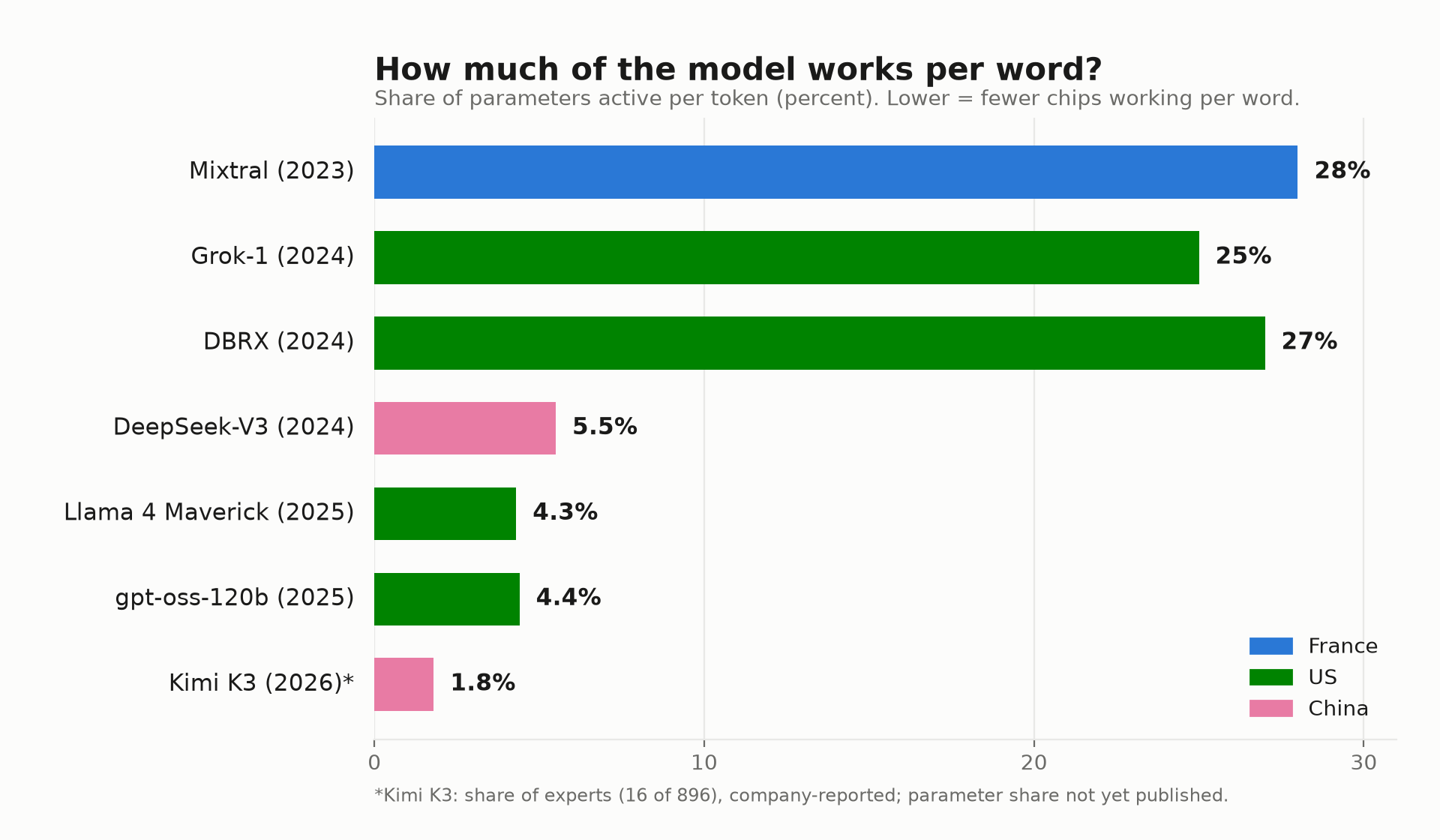
So, is this a Chinese idea? No. The idea is shared world engineering. What the Chinese labs did is push the dial furthest, publish complete technical reports about it, and release the files. The influence now runs in both directions.
Why does this race matter so much? Because a model this big does not live on one chip. It is spread across dozens of computer chips in a data center, and every word must travel between those chips to reach its experts. Every trip costs time and electricity. The fewer parts of the model each word wakes up, the fewer trips and the smaller the bill. This is the hidden reason efficiency wins: the real cost of AI is not the size of the model, it is the traffic inside the data center.
One caution: a lower percentage is not automatically better. It is a dial. Turn it too far and quality drops, and the router needs careful balancing so some experts do not sit unused.
Update, 27 July 2026: Moonshot released the K3 weights, so the figures here now come from the published model card and config file rather than the company blog [14]. That release corrected one number in this article. Active parameters are 104 billion, about 3.7 percent of the total, not the roughly 2 percent you get from the expert count alone. Sixteen of 896 routed experts are picked per word, but two shared experts, the attention layers and one dense layer stay active for every word as well, so the parameter share is higher than the expert share. The rest held: 896 experts, 16 per token, two shared experts, MXFP4 weights, and a 1,048,576-token context. The attention stack is 69 KDA layers to 24 gated MLA layers across 93 layers.
Active parameters vs total parameters: what is the difference?
Now the payoff. Two numbers describe every modern model, and they answer different questions.
Total parameters decide how much MEMORY you need to hold the model. Active parameters decide the SPEED and the cost per word. Take a model with 30 billion total and 3 billion active. It needs the memory of a big model. It runs at the speed of a tiny one. And it thinks somewhere in between: clearly better than a small model, not equal to a big one.
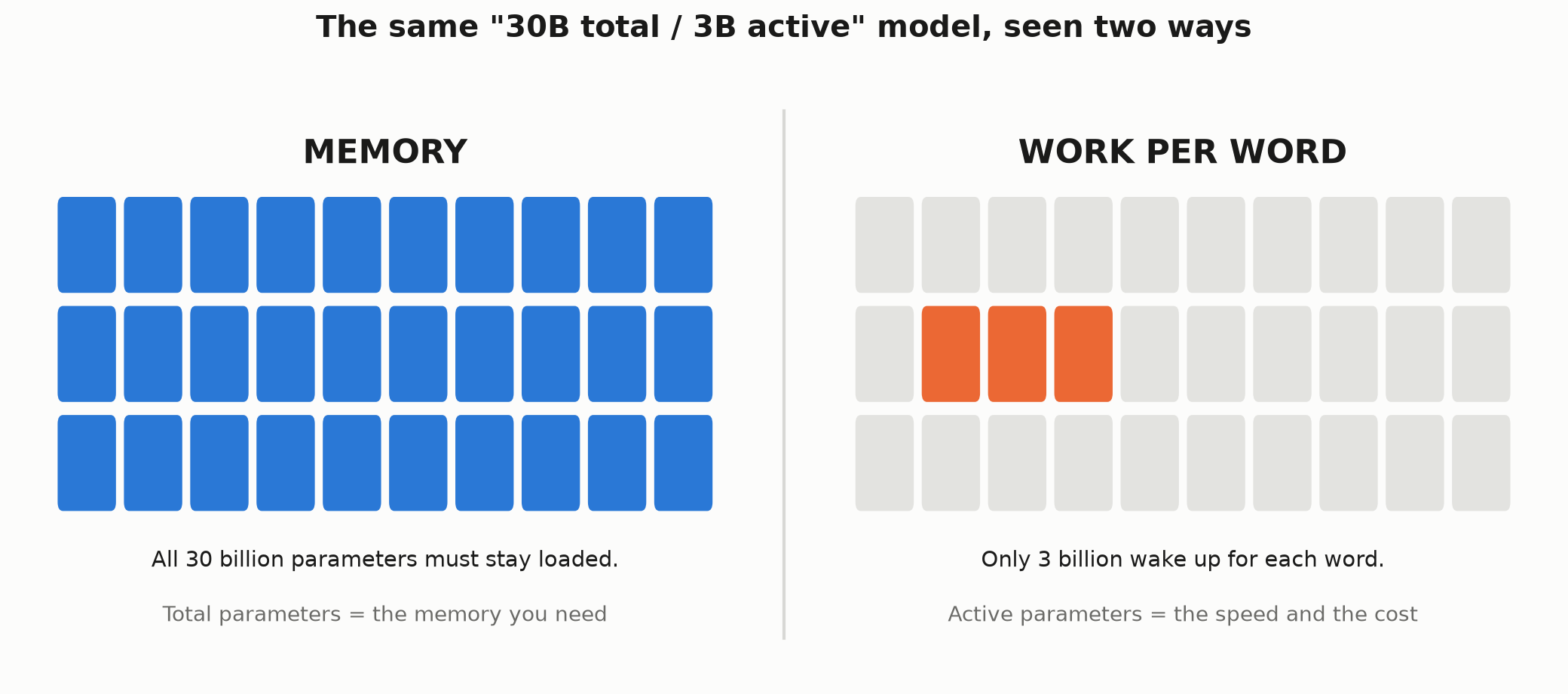
Active parameters determine speed. Total parameters determine memory. That is why modern MoE models can feel dramatically smaller than their headline numbers suggest.
Three things to remember
- Total parameters tell you the memory needed.
- Active parameters tell you the speed and the cost per answer.
- A lower active percentage is not automatically better. It only helps if quality stays high.
Next time a model launches, read past the headline number and look for both: total parameters, and active parameters. The second one is the story. Once you understand that distinction, AI headlines become much easier to interpret. You stop asking “How big is the model?” and start asking “How much of it actually works for each word?”
One question remains, and it deserves its own post:
If the model is so efficient per word, why is a million-word conversation still so hard?
Because the bottleneck isn't the experts. It's somewhere else.
In Part 2: Why Long Context Is Hard - the KV Cache, MLA, and Kimi Delta Attention, explained just as simply.
The headline says 2.8 trillion. The story is the 104 billion.
Quick questions and answers
What is a Mixture of Experts model, in one sentence?
A big AI model split into many small parts, where a tiny decision-maker wakes up only a few parts for each word, so a huge model runs at a small model's cost.
Do the experts specialize in subjects like math or poetry?
No. Researchers who looked inside found patterns like code indentation and common words, not human subjects. Nobody assigns the jobs; the routing patterns appear on their own during training.
Is Kimi K3 really the biggest AI model in the world?
Nobody can say. It is the largest OPEN model announced so far, at 2.8 trillion parameters by the company's own numbers. Closed labs like OpenAI, Anthropic and Google do not publish the sizes of their top models.
Is Mixture of Experts a Chinese invention?
No. The idea is from 1991, Google scaled it, a French lab made it famous in open models, and US models like Llama 4 and gpt-oss use it today. Chinese labs pushed the efficiency furthest and published the most details.
What should I look for when a new model launches?
Two numbers. Total parameters tell you the memory it needs. Active parameters tell you the speed and cost per word. The second one is usually the real story.
Sources and references
Numbered by where they support this article.
- Jacobs, Jordan, Nowlan, Hinton: Adaptive Mixtures of Local Experts, Neural Computation, 1991. Supports: the 1990s origin of the idea (section: What is a Mixture of Experts).
- Shazeer et al.: Outrageously Large Neural Networks: The Sparsely-Gated Mixture-of-Experts Layer, 2017. Supports: Google reviving sparse MoE in 2017; the early expert patterns like adjectives and articles (sections: What is MoE; The expert myth).
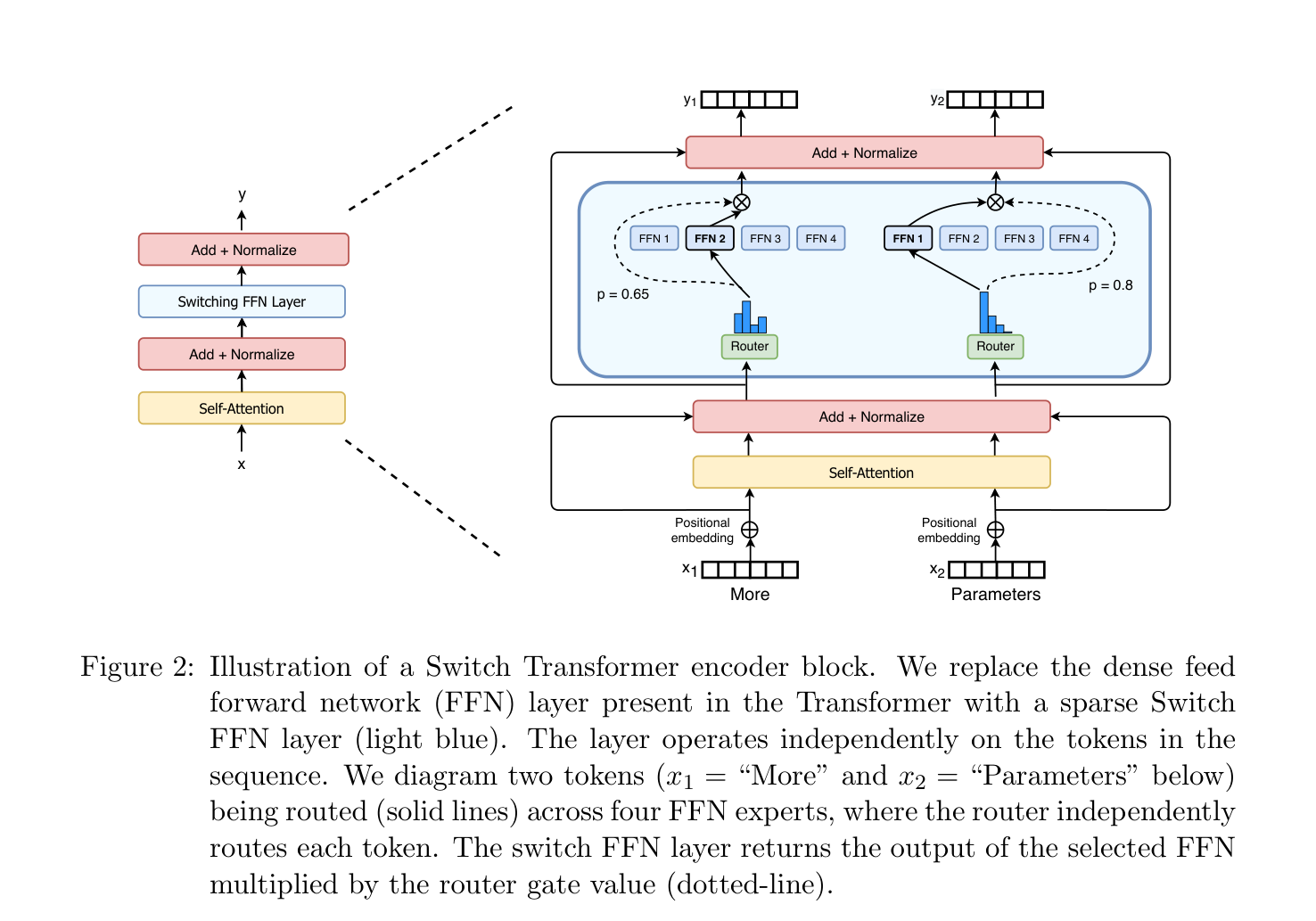
- Fedus, Zoph, Shazeer: Switch Transformers, 2021. Supports: Google's trillion-parameter, thousands-of-experts scaling; the router diagram reproduced above as Figure 2 (sections: What is MoE; the diagram).
- Lepikhin et al.: GShard, 2020. Supports: Google's early scaling to hundreds of billions of parameters (section: What is MoE, history).
- Rajbhandari et al.: DeepSpeed-MoE, Microsoft, 2022. Supports: the always-awake helper expert existing at Microsoft in 2022 (section: DeepSeek's design).
- Jiang et al.: Mixtral of Experts, Mistral AI, 2024. Supports: the 8 experts / pick 2 example, 47 billion total vs 13 billion active, and the finding of no clear subject specialists (sections: What is MoE; The expert myth; the chart).
- Grok-1, xAI, 2024. Supports: the Grok-1 bar in the chart.
- DBRX, Databricks, 2024. Supports: the DBRX bar in the chart.
- Dai et al.: DeepSeekMoE, 2024. Supports: fine-grained experts and shared experts (section: DeepSeek's design).
- DeepSeek-V3 Technical Report, 2024. Supports: 671 billion total / 37 billion active, 256 experts (section: DeepSeek's design; the chart).
- Llama 4, Meta, 2025. Supports: Llama 4 as a US MoE model using a shared expert (history section; the chart).
- gpt-oss model card, OpenAI, 2025. Supports: the gpt-oss bar in the chart and US adoption of extreme sparsity.
- Google announcement of Gemini 1.5, 2024. Supports: Google saying its Gemini models use MoE (history section).
- Kimi K3 model card and config.json, Moonshot AI, released 27 July 2026, alongside the Kimi K3 tech blog. Supports: 2.8T total and 104B activated parameters, 896 experts with 16 selected per token, 2 shared experts, 93 layers as 69 KDA plus 24 gated MLA, MXFP4 weights with MXFP8 activations, and the 1,048,576-token context (intro; the chart; the update note).
About this article: written by Mohamed Kadri, a technical manager working in telecom network operations who builds and runs AI agent systems hands-on. Every number above was checked against the primary paper or official release listed. The Kimi K3 figures were company claims when this was first published; they were re-checked against the released model card and config.json on 27 July 2026, and the active-parameter figure was corrected from roughly 2 percent to 104 billion, about 3.7 percent. Last updated: July 27, 2026.
Part 2 of this series: Why Long Context Is Hard: the KV Cache, MLA, and Kimi Delta Attention. More on operating AI in production: Your AI Agents Need a NOC and Who Operates the Operators?